|
Soundclip:
| |||||
|
See Steve's Hand-Written Lead Sheet
|
| Steve
Khan's "¡Cá-ni-mo!" Lead Sheet
| Though
I'm not exactly certain just where I should begin in offering an analysis
or explanation of this tune, I thought that I would at least begin with
the title and from where it is derived. In truth, it's actually very simple.
The influence is from my favorite Salsa DJ in Caracas, Venezuela. He goes
by the nickname of "El Tigre" Rafael and he can be heard daily
on 106.5 FM. Like many popular DJs, all over the world, he has a signature
"expression" which one can hear before, during and after any song he might
play. His is simply "¡Ánimo!" and he accentuates each
syllable with great zeal. So, to my ears, it sounds more like "¡Á-ni-mo!"
As Pablo Guzmán explains in his liner notes to |
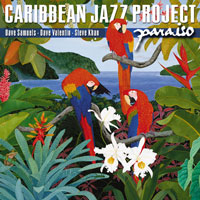 "PARAÍSO,"
it means: "C'mon, show some life, MOVE!" I guess it's not too different
from someone saying in English slang, "GET DOWN!" So, when I was searching
for a title for this piece, I simply broke-up the syllables and added
a 'C' to the front. The title seemed
like a good idea at the time. But that was then, now let's get to the
music. "PARAÍSO,"
it means: "C'mon, show some life, MOVE!" I guess it's not too different
from someone saying in English slang, "GET DOWN!" So, when I was searching
for a title for this piece, I simply broke-up the syllables and added
a 'C' to the front. The title seemed
like a good idea at the time. But that was then, now let's get to the
music. I've actually had this piece of music laying around, in various forms, for years. Perhaps for as many as ten! I don't know exactly why, but I was just NEVER able to complete it until recently. I even got so frustrated with it that at one point, I sent what I had out to Russell Ferrante and Jimmy Haslip of the Yellowjackets to see if they wanted to collaborate and complete it. More recently, when Michael Brecker told me that he was about to record in an organ trio setting, I told him that I thought I had something that would be great for him. So, I sent him the score, as it existed then, and told him that we could collaborate and that he could change or add anything which he felt would be right for him. I only told him that the 'feel' or 'attitude' of the piece, from a rhythmic perspective, was that of the kind of Afro-Latin drum groove that both Elvin Jones and Art Blakey play: using the bell of the ride cymbal, and an alternating pattern with the cross-stick on the snare and a tap on the high tom-tom. I guess Mike liked what he saw/heard because within an hour or so he phoned me to play the little demo he had sequenced. However, as his recording approached, not much more work was done on it, and it never appeared on the CD. So, I was still 'stuck' with the tune. As the new Caribbean Jazz Project recording was approaching, I knew that I could complete the piece and that it was going to finally find a 'home.' The fundamental 'theme' or 'groove-setter' of the piece at [I] had always existed and was always appealing to me. My problems began with what we now call the "break lines" in [A] and [A2]. It just seemed that I could never find a way to be happy with them, and I always felt that there had to be something better. I probably would have kept tinkering with them as long as time would have allowed. Of course, then the tune would NEVER have been completed. A classic way of avoiding finishing things and having to stand by them. One thing one hopes for with any composition is that it would sound musical when played by any instrument. So, for me, I don't ever want something to sound as if it was "written on the guitar." Or, that it was "written by a guitar player." Here I have my doubts, but fortunately, it's being played by guitar, vibes and flute so that helps greatly in lessening those feelings. The various appearances of the [I] sections all have different little endings to them. And, in the end, I suppose that those bars have a rather "gospel" or even "classical" feel to the harmony as the movements are simple and the voice-leading is very logical. One little movement, which goes by very quickly, and is hardly noticeable, appears in bar 4 of [I] and that, I actually associate with James Taylor and one of his tunes from the "GORILLA" album. Actually, the influence of James' guitar playing is felt again, later in the tune, just two bars before [C2]. Simple voice leading to serve a modulation: D-Major to Bm7 to Am/C and finally to C#-minor. It's actually one of my favorite little harmonic moments in the piece. Prior to the "PARAÍSO" recording, [B] never existed though I felt that a contrasting section to [A] was necessary. Somehow, it just came to me to make use of one of the oldest devices in this music, and that is to simply go to the IV chord for a bridge. For example, how many times has James Brown done that successfully? And, here we probably have the "notey-est" passage I've written in sometime, but it does have a very Bebop feel to it which I like very much. This section was also written and rewritten many times, with small changes in the selection of notes right up to the night before the actual session. When I recorded my own little sequenced demo for this tune, I employed a "plena" groove(a fantastic rhythm from Puerto Rico) from beginning to end. But, when we were working out the tune with full rhythm section, as things turned-out, [B] is now the ONLY section where they play a "plena." [C2] gives us our third section and a third harmonic area as well, and sets up the groove for the melody which appears at [D]. This groove is really a reharmonization of familiar material from our [I] sections which have appeared throughout. The [D] melody is one of my favorite parts of the piece, and shortly after the demo had been recorded, while practicing and playing along with it, I accidentally improvised a slight rhythmic change which you see and hear on the repeats of [D]. It shows that it's never too late to add or change something for the better! This brings us to the solo section, [E]. Here, I just wanted to create an open harmonic feel where both Dave Samuels and I could explore things freely. 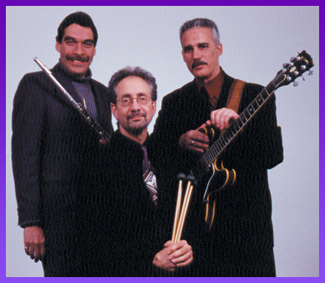 It's a simple 'E'-pedal
which utilizes familiar rhythmic material from the [I] sections.
[E2] is a looser version of [B]. What you can see is that
I have simply expanded the original one-bar phrases so that they are now
two-bars in length to facilitate improvising. I have always been a firm
believer in the notion that you donít have to improvise over the composed
sections exactly as they exist. You can and should make adjustments
so that soloing feels natural and musical to you! Then there is a return
to [E] before making the transition to C#m/F# for [E3].
During a 'live' performance of this piece, it would be my instinct to
open-up the [E] and [E3] sections, but when recording, with
potential time constraints, this is not always so simple or easy. It's a simple 'E'-pedal
which utilizes familiar rhythmic material from the [I] sections.
[E2] is a looser version of [B]. What you can see is that
I have simply expanded the original one-bar phrases so that they are now
two-bars in length to facilitate improvising. I have always been a firm
believer in the notion that you donít have to improvise over the composed
sections exactly as they exist. You can and should make adjustments
so that soloing feels natural and musical to you! Then there is a return
to [E] before making the transition to C#m/F# for [E3].
During a 'live' performance of this piece, it would be my instinct to
open-up the [E] and [E3] sections, but when recording, with
potential time constraints, this is not always so simple or easy. Between solos, [D2] is used as an interlude. It's a simple device but gives the overall piece of music form, structure, and continuity. After the last solo, we move on to [I2] and a brief statement of our 'break lines' at [A3]. However, only the first line appears as it did before. A new line is introduced at bar 7 and is, for this one time, played by all the melodic instruments in unison. For the ending, I have employed a [Tag] which fundamentally reharmonizes elements from our various [I] sections and, in doing so, takes them to new areas for a rather 'peaceful' conclusion to a very active, and intensely rhythmic piece. I really can't say enough about the contributions of bassist Rubén Rodríguez, and percussionists Richie Flores and Luisito Quintero who all added bits and pieces of themselves to make this tune what it is now. It could never have come out this way without their input and energetic performances. One of the reasons that we are posting the mini-score at the website is so that you can see what I had written for the bass part(which, by the way, sounds functional and fine on my demo) but, when you hear what Rubén actually played you will see just how much spirit and personality he added to the written notes. Again, the written notes are not, and should not be, something to be considered as "written in stone." They are just a guide, a place to begin. You have to allow your bandmates to express themselves. After all the years of struggling, to finally get this piece finished and recorded has been a most rewarding experience for me. And even though it sadly appears so late in the CD sequence, I'm so pleased with how everyone seems to respond to it. As always, enjoy the music with my best wishes, and as "El Tigre" Rafael would shout: "¡Á-NI-MO!"
[Photo: Dave Valentín, Dave Samuels, and Steve
Photo by: Richard Laird]
| |