Steve Khan's Acoustic Guitar Solo on:
"Green Room"(Ralph Towner)
After learning that my old, guitarist/composer had passed away Ralph Towner this past January 18th, 2026, I embarked down a path where I thought and thought about Ralph, listened to many of my favorite CDs and the music that he had written and performed and wrote the TRIBUTE that many of you have now seen and read. Ralph left behind for us a real-life treasure trove of rich, sophisticated and moving music. What greater tribute to this maestro could there be? I began to wonder aloud to myself, "Could I possibly come up with a fitting musical tribute to Ralph that could be heard as being worthy of the music that he leaves behind?"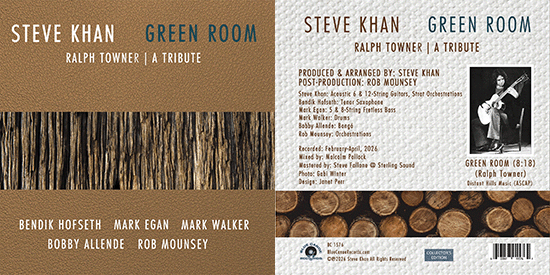 Throughout all of this, his magnificent 1978 ECM album, "BATIK", which featured Eddie Gómez and Jack DeJohnette kept coming back to me. I love all of Ralph's compositions on that album, but the rhythmical ballad, "Green Room" became ever-present in my mind and musical thoughts. As much as I had loved and enjoyed that piece and its performance on the album, I had never fully attempted to transcribe it or to really come to terms with understanding it. And so, the first step on the journey became taking the time and effort needed to write out a functional lead sheet that might help me to unlock some of "Green Room"'s secrets. It took seemingly forever to commit to a written version. That is how difficult it was. Throughout all of this, his magnificent 1978 ECM album, "BATIK", which featured Eddie Gómez and Jack DeJohnette kept coming back to me. I love all of Ralph's compositions on that album, but the rhythmical ballad, "Green Room" became ever-present in my mind and musical thoughts. As much as I had loved and enjoyed that piece and its performance on the album, I had never fully attempted to transcribe it or to really come to terms with understanding it. And so, the first step on the journey became taking the time and effort needed to write out a functional lead sheet that might help me to unlock some of "Green Room"'s secrets. It took seemingly forever to commit to a written version. That is how difficult it was.
As I went along, adding more details to my transcription, more questions would arise that remained so hard to answer. The piece was so melody-driven with harmony applied to and implied by those melodies that it became difficult to put chord names to some of the sonorities as they could pass by so quickly. Even now, with the project completed, I still question my own labeling of the chord symbols. But, they seemed to serve as, at the very least, functional for my harmonic bandmates on this adventure. As my process of studying Ralph's original developed, I came to understand that the composition has two basic sections which I labeled as [A] and [B] with [A] having 17 bars and [B] having, more or less, 10 bars. Those 10 bars were made up of 3 3-bar motifs with an extra 4/4 afterwards to turn the piece back around to Ralph's soloing format. I would imagine that there was not too much rehearsal time for each of Ralph's 5 compositions on "BATIK" with "Green Room" being especially complex, from a recording perspective, as Ralph would record the basics of the piece with Eddie and Jack while playing acoustic piano, and then, overdubbing his acoustic 12-string after the basic had been performed. In the greater tradition of Jazz, Ralph simply had his piano, his 12-string and Eddie's bass solo over the form of tune - just as most standards would require. On the original version, the acoustic piano solo is first, followed by Eddie and then Ralph's overdubbed acoustic 12-string to finish out the solos. The piano solo flows right into the restatement of the [B] melody followed by a complete statement of both [A] and [B] with a 2-bar Coda leading into a full Outro which, for this version, spans some 2-minutes of improvising.
Where composing and arranging are concerned, one has to engage in a goodly amount of thought and preparation and I wanted to add some touches to what Ralph had provided us all with by using the first 4 bars of [A] as a recurring theme. So, before the 1st solo, the acoustic guitar solo, you have one such restatement, and then, after the guitar solo and before Mark Egan's magnificent fretless bass solo, another reprise which precedes Bendik Hofseth's tenor sax solo. However, after Bendik's solo, we simply restate one of the 3-bar phrases from letter [B] before a complete restatement of our main melodies within [A] and [B]. Then, just as Ralph had laid out, we take what became a Double Coda moving us to our Outro and some 3-minutes of group improvising with Bendik leading the musical conversation.
Where the specifics of our Solo Format are concerned I also made a couple of minor adjustments to make the soloing have an easier flow to it. So, unlike Ralph's version, I had the 1st 4 bars going from i-iv-iv-i - Cm-Fm6-Fm6-Cm - one bar for each chord. It allows the soloist to begin with a rather classic plagal cadence idea - which is very much in keeping with those elements in Ralph's piece. As "Green Room" form in bars 5-9 moves along, the soloing continues with the chords as I finally heard them, those being a bar each of G7(9/13)/A to Dbmaj7/Ab and then, G7(alt.) finally landing on 2 bars of Eb/E. As it is throughout most of the presentation, all of the chords receive colors from my Strat orchestrations and harmonics splashes from my acoustic 12-string à la Ralph. The next 4 bars, beginning with bar 10, fundamentally sees the harmony centered around Cm9/D or a most Phrygian/Spanish sounding area. During the Ralph's melody he had the harmony moving through a moment of B/D. In that moment, the Eb of the prior chord becomes D# (enharmonically spelled) but now, with the presence of the B-natural, the modality could be viewed as being C melodic minor/D [C, D, Eb, F, G, A, B]. For a moment, the Bb disappears. Now, we come to bars 14-17, I laid out the changes as I had been hearing them beginning with that same Cm9/D to Db/D and finally to G7(alt.) for 2 bars. But, if I had to re-do this? I would adjust these changes to more accurately reflect what Ralph composed. So, the Db/D chord would become Dmaj7#5 or F#/D and the G7(alt.) chord would become Gmaj7#5.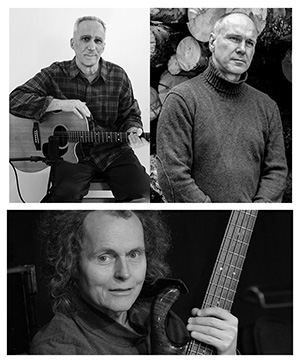 For improvising, the modes/scales for each of those two latter chords would become D Lydian Augmented: [D, E, F#, G#, A, B, C#] and G Lydian Augmented [G, A, B, C#, D#, E, F#]. With Dmaj7#5, you still have both Db(C#) and D-natural in the sound but F-natural and Ab are gone. This has all served to teach me, yet again, that there is always something to be learned - sometimes, one is learning an old lesson anew. And lastly, instead of having [B] and its interesting but difficult phrases to solo over, I took those chord changes and basically gave them a bar each. So you now have: | Eb/E | G/F | G/Ab | G/Ab |. I believe that this small change made soloing life easier for me, Mark and Bendik. Now, let's take a look at the specifics of what I played during my acoustic guitar solo For improvising, the modes/scales for each of those two latter chords would become D Lydian Augmented: [D, E, F#, G#, A, B, C#] and G Lydian Augmented [G, A, B, C#, D#, E, F#]. With Dmaj7#5, you still have both Db(C#) and D-natural in the sound but F-natural and Ab are gone. This has all served to teach me, yet again, that there is always something to be learned - sometimes, one is learning an old lesson anew. And lastly, instead of having [B] and its interesting but difficult phrases to solo over, I took those chord changes and basically gave them a bar each. So you now have: | Eb/E | G/F | G/Ab | G/Ab |. I believe that this small change made soloing life easier for me, Mark and Bendik. Now, let's take a look at the specifics of what I played during my acoustic guitar solo
The solo begins with a very symmetrical phrase that, over the 4 bars, answers itself. I used elements from Ralph's main melody without really quoting any of it directly. As these very simple changes could easily indicate a bit of a minor blues, the chromaticism 3-4 is very much blues related. And then, we hit bar 5 which begins a passage that was, for a time, the most difficult passage to hear through - just the changes alone. As a listener, it all made sense but trying to make better sense of them really took some time. As I have now notated, I came to hear the chord in bar 4 as G7(9/13)/A. The F-natural in the lower register of the sonority made the labeling of the chord tricky for me. Others might disagree. Initially I had labeled it as Dm9/A. But even though the modes would be the same, that chord character felt off to me. As Ralph has a lovely descending bass line: A-Ab- G, still labeling the chord in bar 6 was difficult for me too. At first, I thought that it might be an Abmaj9/6 chord, but that never felt right to me as heard through and played through this passage. In the end, you can see how nicely the Db triad that I played sits in the harmony. That said to me that I had to label this chord as Dbmaj7/Ab. In bar 6, the line over the G7(alt.) chord covers 3 of the 4 altered tones: b5(Db); #9(Bb) and #5(Eb/D#). Landing on Eb leads me right into the Eb/E sonority. With the chromatic line in bar 7, it is almost as if I was hearing Eb as the center and the E-natural in the bass almost becomes incidental.
In bar 8, we arrive at Cm9/D which I would always describe as a Phrygian sound. And, as D Phrygian and C Dorian have the exact same notes it just depends on one's modal orientations: [C, D, Eb, F, G, A, Bb]. When I was playing, I really was not aware of just how great an influence Ralph's 12-string solo from the original version was going to be. For example, the opening phrase in bar 8 now reminds of something that Ralph played at 1:49 of his "Green Room" solo. Then it seems that I took the small rhythmic grouping of Ralph's with 2 16th-notes and an 8th-note and turned that into a more developed thematic device that you hear from bar 10-13. When I realized this, long after having played it, I was really quite surprised. In bars 14-15, over the G7(alt.) chord, I am playing elements of the b5 substitute, Db7, much of it arpeggiated, which creates so many of the altered tones over G7: Cb(3rd)-Eb(#5)-F(7th)-B(3rd)-Ab(b9). The key to playing like this is to have learned to simply HEAR THIS WAY long before one plays such things. You have to believe it yourself! So, landing on an Ab can't work without that belief. Notice how beautifully and seamlessly drummer Mark Walker picks up on my triplets and uses those rhythms to bring us into the last 4 bars of the solo bars 18-21. Even with such complex chords, if one focuses on the beauty of the chordal tones the lines will flow into one another. So, over the Eb/E chord, I zeroed in on the note Bb. Over the G/F sonority, B-natural seems to stick out to me though there is also a sense of D minor pentatonic too: [D, F, G, A, C]. Lastly, over the G/Ab chord, I focused initially on D-natural, the 5th of the G-triad, but ending in the last bar with the emphasis on B-natural, the 3rd of a G-triad.
If you are looking for scale or modal solutions to a chord/sonority like Eb/E, you could think of it in a few ways. Perhaps one might be, Eb 1/2-tone whole-tone diminished scale [Eb, E, Gb, G, A, Bb, B, Db]. Within that scale, you have your Eb triad along with your E-natural. The chord at its most simple level could resemble the guts of a C7(alt.) chord. So, you might be able to apply the C altered dominant 7th scale [C, Db, Eb, E, Gb, Ab, Bb]. Here you might not have your Eb triad, but you do have both Eb and E-natural. What about Eb minor pentatonic: [Eb, Gb, Ab, Bb, Db] or Gb dominant 7th pentatonic: [Gb, Ab, Bb, Db, Fb] or even Ab dominant 7th pentatonic [Ab, Bb, C, Db, Gb]. When the diminished scale truly becomes an improvising option, within any diminished scale you are going to find both major and minor triads existing at the same time. In the Eb diminished scale mentioned above you could find both: Ebmaj/Ebmin; Gbmaj/Gbmin; Amaj/Amin; and Cmaj/Cmin. They are all there. In the last chord of the solo section as I conceived of it, we have G/Ab and this is simply giving you the same options a maj3rd above Eb/E. But, in the end, you are still going to have to resolve to C minor and this is why you could view the Ab as the b9 of G7(alt.) for example and apply G altered dominant scale [G, Ab, Bb, B, Db, Eb, F] over the very same sonority. Had there been more choruses for everyone, this could have easily been put to use.
In my own original Lead Sheet transcription of Ralph's original version, in bar 16, I had the chord as G7(alt.) but in bar 17, I thought that I heard him playing B/G or Gmaj7#5. Yes, that's right! A chord/sonority with no b7 and, of all things, the natural 13th (E-natural) in the mode. In almost any genre of music, when one is resolving to minor, you really do not want to have the natural 13th of the V7 chord resolving down to the minor 3rd of the coming im7 chord.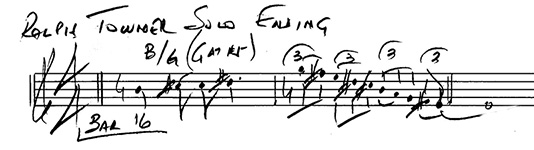 This just does not sound good to most ears. But, in my experience, having played so much of Randy Brecker's tunes, he often did this. In his great tune, "The Big Ones" he had his V7 chord as Emaj7#5 resolving to Am7!!! Yes! And it sounded great!!! Go figure. And so, on the original version, during Ralph's acoustic 12-string solo, in bar 14, I now clearly hear him playing over a Dmaj7#5 (F#/D). From there, in bar 16, Ralph plays a long descending line in triplets to close out his solo beginning on a high G-natural and going down and ending on an E-natural. I can't tell you how many times that I have heard this line go by and always thought that it sounded great - but, believe it or not, I could not understand HOW it could possible sound great over what I always thought was a G7(alt.) chord. The notes that Ralph plays just seem to be a descending G Lydian Augmented scale [G, A, B, C#, D#, E, F#] beginning on a high G-natural. This was always a complete and total mystery to me. But, only recently, in the days following the actual completion of mixing and mastering, etc. - and beginning to write about this entire experience, did I finally HEAR what had been going on during Ralph's solo the whole time. In fact, until that moment, I simply never HEARD the chordal sonority correctly. In the end, Ralph is playing Gmaj7#5. When seen this way? Everything suddenly makes perfect sense! This beautiful moment occurs @ 1:57 if you are listening to the original recorded version. This just does not sound good to most ears. But, in my experience, having played so much of Randy Brecker's tunes, he often did this. In his great tune, "The Big Ones" he had his V7 chord as Emaj7#5 resolving to Am7!!! Yes! And it sounded great!!! Go figure. And so, on the original version, during Ralph's acoustic 12-string solo, in bar 14, I now clearly hear him playing over a Dmaj7#5 (F#/D). From there, in bar 16, Ralph plays a long descending line in triplets to close out his solo beginning on a high G-natural and going down and ending on an E-natural. I can't tell you how many times that I have heard this line go by and always thought that it sounded great - but, believe it or not, I could not understand HOW it could possible sound great over what I always thought was a G7(alt.) chord. The notes that Ralph plays just seem to be a descending G Lydian Augmented scale [G, A, B, C#, D#, E, F#] beginning on a high G-natural. This was always a complete and total mystery to me. But, only recently, in the days following the actual completion of mixing and mastering, etc. - and beginning to write about this entire experience, did I finally HEAR what had been going on during Ralph's solo the whole time. In fact, until that moment, I simply never HEARD the chordal sonority correctly. In the end, Ralph is playing Gmaj7#5. When seen this way? Everything suddenly makes perfect sense! This beautiful moment occurs @ 1:57 if you are listening to the original recorded version.
Within my arrangement, Ralph's Outro section, which lasted for 2-minutes, becomes my Letter [F] and our Outro lasts some 3-minutes. Each "section" of [F] lasts 8 bars. In my case, I tried to shape the arc of the section in ways that might prolong the state of flow and space while adding some points of interest. Part of the concept was to allow drummer Mark Walker to make the transition from stately brushwork to sticks and the pinging of cymbals. As I mentioned elsewhere, while singing the praises of bassist Mark Egan, I had planned that at [F4] there would be shift in the motion of the section and the piece. Here, Mark Egan would begin to play his very special brand of harmonics on his Pedulla 8-string bass and, as they percolate beneath everything, Mark Walker adds in the pinging of his majestic Paiste flat ride. This whole "vibe" or "wave" continues until we have faded out. This is also another subtle tribute to Ralph Towner that calls to mind, at least for me the title track from the "BATIK" album.
In another time that now feels like ages ago, we used just write: VAMP 'TIL FADE! Yes, there is something to be gained from that in the creation of some kind dreamscape ambience which allows a listener to do just that: dream! But, that approach can ignore many of the compositional aspects that have come before. And be assured that the music of Ralph Towner is all about composition. In Ralph's Intro he is painting a portrait of a mood which centers around a very basic plagal cadence, there you have Cm-Fm6 for some 16-bars.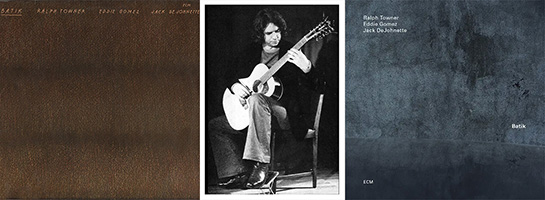 In Ralph's Outro, he transitioned to/modulated to E minor, and when he performed the acoustic piano, you hear at the end of each bar he plays Am to resolve back to Em. The modality becomes E Aeolian [E, F# G, A, B, C, D] Ironically, the rhythmic feel has a very Latin component to it. So, in my arrangement and approach, I wanted to observe this touch of Ralph's and in order to do so, I asked Rob Mounsey if could please have his flügelhorns play the necessary intervals of the 6ths from Am to Em - but we did this every 4 bars for a time. As i knew that Bendik Hofseth was going to be a part of this, I designed this section, a pretty long one, so that it could feel like a conversation was happening between Bendik and my acoustic guitars with, of course, Bendik leading that conversation. Along the way, I asked Mark Egan to play a small fragment of the main [A] melody which occurs at 6:42 of the performance. I also had Rob add a touch of what he called his melodic flutes for emphasis, color and depth. Later, in the Outro as the actual Fade is well underway, you hear my acoustic guitar play this same melodic fragment @ 7:44. It is touches like these that, even if only subliminally for the listener, has a way of tying the whole piece together - a connection to where it all started. It reflects that it is all part of something larger and not just a bunch incessant jamming. In Ralph's Outro, he transitioned to/modulated to E minor, and when he performed the acoustic piano, you hear at the end of each bar he plays Am to resolve back to Em. The modality becomes E Aeolian [E, F# G, A, B, C, D] Ironically, the rhythmic feel has a very Latin component to it. So, in my arrangement and approach, I wanted to observe this touch of Ralph's and in order to do so, I asked Rob Mounsey if could please have his flügelhorns play the necessary intervals of the 6ths from Am to Em - but we did this every 4 bars for a time. As i knew that Bendik Hofseth was going to be a part of this, I designed this section, a pretty long one, so that it could feel like a conversation was happening between Bendik and my acoustic guitars with, of course, Bendik leading that conversation. Along the way, I asked Mark Egan to play a small fragment of the main [A] melody which occurs at 6:42 of the performance. I also had Rob add a touch of what he called his melodic flutes for emphasis, color and depth. Later, in the Outro as the actual Fade is well underway, you hear my acoustic guitar play this same melodic fragment @ 7:44. It is touches like these that, even if only subliminally for the listener, has a way of tying the whole piece together - a connection to where it all started. It reflects that it is all part of something larger and not just a bunch incessant jamming.
To further tie everything together I also played two quotes from the melody of Ralph's "Waterwheel" - another favorite of mine from the "BATIK" album. This melodic fragment happens @ 6:13 and is repeated @ 6:29. Rob also stepped in and added a touch of our pizzicato strings to highlight this wonderful little melody of Ralph's. All the while, Bendik's tenor sax weaves in, out and around the sandwich of guitars. It is fascinating to me that Ralph's original composition is played in the meter of 11/8 and centered around an ostinato based upon Ralph's nylon-string figured which hypnotically informs the whole piece. There's almost not enough space for the melody to even squeeze in. Within my arrangement, even playing the fragment over 4/4, it can still feel like it is in a super-imposed meter.
Though Ralph Towner and I had already recorded together on February 5th, 1972 for a Clive Stevens "ATMOSPHERES"(Capitol) album which featured: John Abercrombie (Guitar); Rick Laird (El. Bass) and Billy Cobham (Drums) and Ralph on Fender Rhodes. I believe that I lent Ralph my Maestro® Ring-Modulator pedal. That album was not released until 1974. But I had noted in that same Datebook that Ralph and I spent some time hanging out, playing music and beginning to become good friends on June 22nd of 1972. That friendship only deepened as the years went by.
One of my favorite shared moments with Ralph took place at Carnegie Hall on September 19th, 1975, a concert that featured the Barney Kessel Trio; Ralph Towner Solo and Larry Coryell with Steve Khan in Duet. What I remember most about that night is that Ralph seemed really glad to see me backstage, and we spent a good deal of time together talking, laughing and reminiscing about everything. My lasting impression of that night was two-fold: [1] Ralph was just chain-smoking like a maniac. He would have barely finished one cigarette and he was already lighting up the following one. It was incredible. He seemed to be wound up and nervous, lots of nervous energy backstage. But then in sharp contrast, [2] Ralph took the stage, and simply played like an angel, so calm, composed, reflective - total magic! I just said to myself, "Man, now that is an artist!" It was so inspiring.
From 2000, Anil Prasad did this wonderful interview with Ralph which he titled, "Unfolding Stories." And then, in 2017, Anil revisited with Ralph and presented a very comprehensive piece which he titled: "Magic and Affirmation." It you are looking for in depth looks into Ralph Towner as a human being and his approach to his instruments and music-making? These are the resources that you must access. If you take the time to read them both, you will come to know the great Ralph Towner in a far more profound way!
I am left to hope that anyone who has visited this page, read the text, listened to our humble interpretation of "Green Room" that you have come to feel and understand something about Ralph Towner's composition and the creative process here that sought to bring a different take on it to life and shine a light on a great piece of music. The journey and the end result came to mean a lot for all of us. Wishing everyone good health, good fortune and the will to pursue your dreams no matter how difficult or far away they might seem.
- Steve, New York City, May, 2026
[Photos: Ralph Towner by: Gabi Winter | Collage: Steve Khan, Bendik Hofseth & Mark Egan]
|